Showing posts with label Galt House Inn and Suites. Show all posts

Thursday, November 1, 2012

Day 2 AECT 2012: Part 1 - Microscenarios

This post is part of a Multiple Part Series on the 2012 AECT Convention.
#AECT 2012


9:15- 10:15 Scenario-based and Standardized Patient Simulations in Nursing Education
The first session I attended was about how to create simulations for nursing students. Catherine Maney of Northern Illinois University presented on how she created simulated live scenarios of mental health patients. The scenario she described was interesting - a bipolar patient in a manic state. I was impressed with the process they used for creating the scenario case:


I like the methodical nature of this task or case creation process, particularly the step of having another faculty member review the scenario. A great way to formatively evaluate a learning scenario.

They used a live actress for the simulation. After following the scenario-creating process, they
  1. ran the simulation with 2 nursing students as the learners
  2. filmed the students in the simulation as they worked through the process of calming the patient, gathering vital signs, deescalating patient's manic behavior, and administering medication.
  3. debriefed the students on how it went by reviewing the video at key points.
  4. had the students self-evaluate their work by asking what they did well, how they might improve.
The presenter mentioned that they also use these recorded scenarios as a way to present examples to later students in the course. This makes sense to me since students, particularly novices, benefit greatly from worked examples of how to approach a particular task. A very good presentation on an application of task-centered instruction, in my opinion.

The second presentation in this session was given by John Jeon and Terry Tao of University of Wisconsin-Extension. They described how they are developing an online scenario-based training.

The presenters described how they worked developed an idea of using what they call microscenarios. They basically broke these scenarios (cases) that they were using previously into pieces and developed an online strategy and technology for delivering and applying that knowledge.

Here are a couple of interesting graphics from the presentation:


Wednesday, October 31, 2012

Day 1 AECT 2012: Ontology, TCL, and Opening Social

This post is part of a Multiple Part Series on the 2012 AECT Convention.
#AECT 2012

It is the end of my first day at the AECT 2012 International Convention. I've enjoyed the presentations and interactions thus far, despite the fact that I helped give one of the presentations... Here are some of my experiences at the conference today.

10:00 - 11:30 IDT Professors Forum
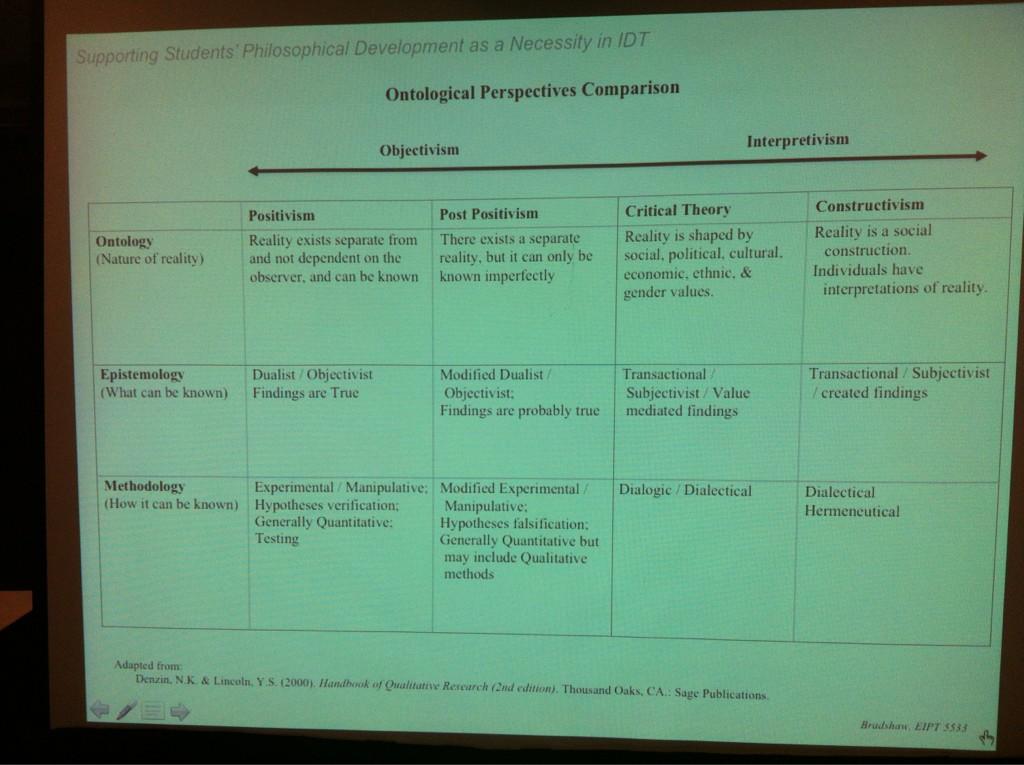
This morning I attended the IDT Professors forum. We talked about how our foundational beliefs about reality, what knowledge is, and how people learn have a profound influence on the way we teach and design instruction. The presenters shared the slide below:

Ontological Perspectives Comparison Table
It was a good discussion - got me thinking about my own underlying beliefs and how they influence my approach to teaching and design.

1:00 - 2:00 Co-presented with Greg Francom - What is Task-Centered Learning?
Dr. Greg Francom and I presented on a paper that we wrote on what task-centered learning (TCL) is. The purpose of the paper was to identify the common elements of several similar models of instruction. We also differentiated TCL from Problem-based Learning (PBL) and showed some of the fundamental differences in the underlying assumptions and applications of each theory.

Fundamental Components of Task-Centered Learning: 
  • Learning Tasks
  • Activation of Prior Knowledge
  • Demonstration/Modeling
  • Application
  • Integration/Exploration
One will note that these principles align quite well with Dr. Merrill's First Principles of Instruction.

Greg during our TCL Presentation


One interesting discussion with the participants revolved around the question of whether or not we should try to synthesize theories together into a coherent framework. There were 2 camps - one thought we should, the other that we shouldn't. In my mind, I think that we should try to make coherence out of the theories and principles that have been discovered and researched by putting them together into a coherent, usable structure. However, this is not to say that we should try to combine everything that has ever been studied into one great ultimate theory of instruction; rather, we should clarify what works when and provide a structure that allows a person to use that knowledge in meaningful, contextualized ways.

Evening Social
After an interesting keynote address, I spent a couple of hours at the Evening Social event. Talked with lots of old friends, colleagues, and professors. It is always fun to get together with my particular brand of nerd (no offense, my fellow-edtech nerds) and talk instructional design and technology. Talked briefly with Dr. Merrill, who has been a great mentor and leader in the field.

Drs. Preston Parker, Joel Gardner, David Merrill, Greg Francom, and Max Cropper

Tuesday, October 30, 2012

The Galt House Hotel and Suites

This post is part of a Multiple Part Series on the 2012 AECT Convention.
#AECT 2012

For this year's AECT Convention, I am staying at the Galt House Hotel and Suites, sharing a room with my good friend John Jeon. A very nice hotel and we are in the same building as the convention, which is a lot nicer than walking a mile or two (like I did at the last conference).

Some photos:

Me in hotel room (yes, that is an ATARI shirt)
  

The hotel room

View of Ohio River from hotel room

View of downtown Louisville from hotel room

The Roommate
John finally arrived late this evening after a cancelled and rerouted flight. John and I have worked together on multiple research projects, written an article together and have been good friends for years, so it was really fun to see him again.

John Jeon